
TMJ Treatment in Burlington
Jaw pain, clicking, and jaw tension treated by a multi-disciplinary healthcare team — co-managed with your dental provider for comprehensive, coordinated care.
Why choose Propel for TMJ Therapy?
- Physiotherapy, chiropractic, and registered massage therapy — under one roof
- Intraoral massage for deep jaw muscle release
- Class 4 laser therapy — clinically supported pain reduction
- Dental co-management available when clinically indicated
- Direct insurance billing · No referral required
Not Sure Where to Start?
** DIRECT INSURANCE BILLING AVAILABLE **
Common Signs and Symptoms of TMJ Disorders
TMJ disorders show up differently for everyone. Some people feel it as a constant dull ache in the jaw. Others notice a click or pop every time they open their mouth. Some wake up with morning soreness they can't explain, or get headaches at the temples that don't respond to painkillers.
If you recognize any of the following, your jaw may be the source:
- Clicking, popping, or grinding when you open or close your mouth
- Jaw pain when chewing, yawning, or talking
- A jaw that feels like it "catches" or briefly locks
- Headaches at the temples — especially in the morning
- Ear pain or a feeling of fullness with no sign of infection
- Neck pain and jaw pain appearing together
- Morning jaw soreness or facial tightness
- A bite that feels "off" or has shifted
- Tooth sensitivity or wear flagged by your dentist
These are all signs that something in your jaw joint, surrounding muscles, or cervical spine isn't working the way it should. The good news: most TMJ disorders respond very well to conservative care — without surgery, injections, or long-term medication.
The Connection Between TMJ Disorders and the Cervical Spine
This is the part most people — and many clinics — miss.
Research shows that about 70% of people with jaw pain also have involvement in the neck and upper cervical spine. The nerves that process pain from your jaw travel through the same pathways as those from your upper neck. This is why jaw pain so often comes with headaches, and why treating the jaw alone frequently produces only partial results.
At Propel, our approach always includes assessment and treatment of the cervical spine alongside the jaw — because in most cases, you need to address both to get lasting relief.
What's causing your symptoms depends on where the problem is coming from:
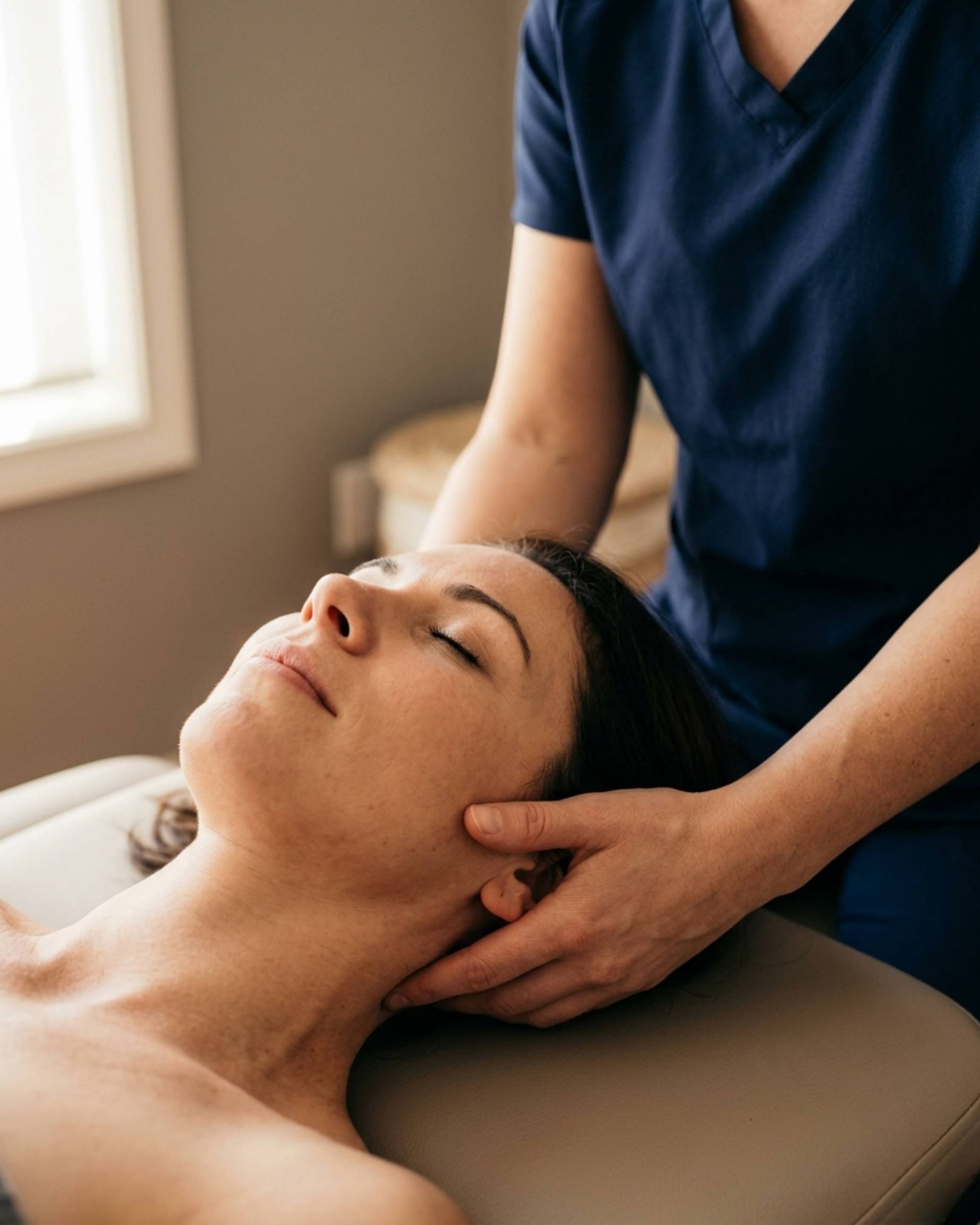
Muscle-Based TMJ Pain
The muscles around your jaw — and often your neck and temples — are overloaded or in spasm. This is the most common type, and typically the most responsive to treatment. It frequently produces referred pain: pressing on a jaw muscle can make your ear ache or your temple throb.
TMJ Joint Pain
The joint itself is the source — whether from the disc being in the wrong position (producing that familiar click or pop), or from inflammation directly inside the joint. Joint-based pain tends to feel like a more localized, deep ache.
Why Burlington Patients Choose Propel for TMJ Treatment
There are clinics in Burlington that offer physiotherapy or chiropractic for jaw pain. What makes Propel's TMJ treatment different is the depth of the clinical team and the coordination of care.
Multi-Disciplinary Under One Roof
Your jaw problem doesn't fit neatly into one discipline. At Propel, physiotherapists, chiropractors, and registered massage therapists all contribute to TMJ care — each bringing a different clinical tool set to the same problem. Your care is coordinated, not fragmented.
Intraoral Massage Therapy
Our registered massage therapists are trained in intraoral technique — hands-on release of the deep jaw muscles that most therapists never reach. Releasing tension in the muscles at the back of the jaw is one of the most effective interventions for stubborn jaw pain and restricted opening, and very few clinics in the area offer it.
Class 4 Laser Therapy
A 2025 review of 44 clinical trials found that Class 4 laser therapy reduces TMJ pain by 60–70% and improves jaw opening by 10–20%. We apply it directly over the jaw joint and affected muscles during the acute phase — so you can tolerate hands-on treatment sooner and progress faster.
Injury Prevention & Recovery
Supple muscles and fascia are far less prone to strains, tears, and overuse injuries. Stretch therapy accelerates post-workout recovery by improving circulation and reducing muscle soreness, keeping you active and pain-free longer.
Medical Acupuncture & Dry Needling
For patients with significant jaw muscle tension and identifiable trigger points, acupuncture and dry needling offer targeted pain relief that manual therapy alone can't always reach. Both are used as adjuncts to your core treatment plan — particularly effective in the early phase when getting pain to a manageable level quickly matters most.
Direct Insurance Billing — No Referral Required
Physiotherapy, chiropractic care and registered massage therapy for TMJ are covered under most extended health benefit plans. We bill your insurance directly. You can book online or by phone — no doctor's referral needed.
Your TMJ Treatment Plan: What to Expect
Every patient starts with a comprehensive assessment. From there, your care follows a structured progression — moving from pain relief, through restoring full function, to a plan that keeps the problem from coming back. Most patients see meaningful improvement within the first four weeks.
Your first appointment includes a thorough assessment and the start of hands-on treatment — in the same visit. We take the time to understand exactly what's happening with your jaw, muscles, and neck, then get to work right away. No waiting until visit two to begin feeling better.
- Jaw joint movement, clicking, and range of motion
- Jaw and facial muscle tenderness patterns
- Neck and upper cervical spine involvement
- Jaw habits that may be driving your pain
- Symptoms, history, and previous treatment
- Treatment already underway — not just a plan for next time
- A clear diagnosis — not just "TMJ" as a catch-all
- An understanding of what's causing your symptoms
- Immediate self-care strategies you can start today
The first phase focuses on getting your pain to a manageable level and calming down the jaw muscles and joint. Most patients notice meaningful improvement in this phase. We use a combination of hands-on treatment, laser therapy, and targeted education — because changing what you do between visits is just as important as what happens in the clinic.
- Gentle jaw joint mobilization (physio/chiro)
- Massage to jaw muscles, neck, and base of skull
- Intraoral massage to deep jaw muscles (where appropriate)
- Upper cervical spine treatment
- Acupuncture for muscle pain relief (if indicated)
- Class 4 laser therapy over the jaw joint and muscles
- Jaw rest position and awareness training
- Identifying and reducing clenching and grinding habits
- Diet and sleep modifications during a flare
- Gentle home exercises to start between visits
Once pain is under control, we progress to restoring normal jaw movement, addressing the cervical spine in depth, and building the strength and coordination that keeps the problem from returning. This phase is where the real rehabilitation happens — and where most patients begin to feel like themselves again.
- Progressive jaw joint mobilization — deeper grades as tolerated
- Intraoral mobilization for restricted jaw opening
- Cervical spine manipulation or mobilization (C1-C2)
- Trigger point treatment (jaw and neck muscles)
- Thoracic spine work for posture correction
- Jaw coordination and movement retraining exercises
- Gentle resisted jaw opening
- Neck stabilization — targeting deep neck muscles
- Postural correction exercises for head and shoulders
- Aerobic exercise — reduces pain sensitivity over time
The final phase transitions you to independence — a full home exercise program, strategies for managing flares if they occur, and clarity on when to return if symptoms resurface. For patients with a dental component, this is also where ongoing coordination with your dental provider happens — monitoring appliance fit, bite changes, and long-term management.
- Full home exercise program — you own your recovery
- A written flare management plan
- Clear guidance on when to return for a tune-up
- Periodic maintenance appointments if needed
- Ongoing coordination with your dental provider for night guard and appliance monitoring
- Bite adjustment referral if jaw mechanics shifted during care
- Long-term tracking of tooth wear and bite changes
- Sleep and airway appliance options if indicated

Everyday Habits That Make TMJ Pain Worse
Beyond the joint and muscles themselves, certain everyday habits significantly load the jaw and keep it from healing — and most patients haven't thought to connect them to their pain:
- Clenching your teeth during the day — often unconsciously when concentrating or stressed
- Grinding your teeth at night (your dentist may have flagged this before any pain started)
- Sustained gum chewing — more than a few minutes places repetitive load on the joint
- Resting your jaw on your hand - Biting nails, chewing pens, or similar habits
- Sleeping on your stomach with your head rotated to one side Prolonged dental work — long chair time is a common trigger
Identifying and changing these patterns is one of the highest-value parts of our care — and something you can start acting on today, regardless of where you are in treatment.
Dental Co-Management for TMJ Disorders
TMJ disorders are often multi-factorial — meaning the solution can require more than one type of provider. Dentists and musculoskeletal practitioners each bring something the other can't. When both work together, patients get a more complete picture and better outcomes.
What Propel Addresses
- Jaw and neck muscle tension
- Joint mechanics and mobility
- Cervical spine involvement
- Intraoral soft tissue release
- Class 4 laser pain management
- Rehabilitation exercises
What Your Dentist Can Address
- Bite position and tooth alignment
- Custom night guards to protect teeth
- Dental appliances for grinding
- Long-term monitoring of wear patterns
- Bite correction when indicated
- Detection of grinding damage early
Following your initial assessment at Propel, if we identify a dental component to your jaw problem, we send a detailed clinical summary to your dental provider — so both teams are working from the same picture. If you don't currently have a dental provider and a referral is indicated, we can help point you in the right direction.
What Burlington Clients Are Saying

Ready to Stop Managing Your Jaw Pain and Start Resolving It?
Whether you've been dealing with jaw clicking for years or you're in the middle of an acute flare, the team at Propel Active is equipped to assess and treat TMJ disorders at a level most clinics can't match — with direct access to dental co-management when you need it.
Got questions about Propel's approach to TMJ treatment?
CALL US or drop us a line below
